
OnlyFans ranking cards promise quick decisions but require careful reading to deliver actual value. BestOnlyFans and similar aggregators compress creator profiles into scannable formats, yet not every number carries equal weight for subscribers seeking reliable content. This guide teaches you to read these cards critically, distinguishing predictive metrics from vanity indicators that waste your subscription budget.

Understanding ranking card anatomy matters because OnlyFans lacks native discovery tools. Without platform-level search or recommendation feeds, subscribers depend on third-party aggregators to surface creators matching their interests. These intermediaries create standardized data presentations that speed comparison—but also introduce abstraction layers where accuracy degrades.
What Ranking Cards Actually Display
Most ranking cards present seven standardized fields. Each claims to measure something specific about creator output or audience relationship, though data quality varies dramatically between sources.
- Subscriber estimates: Third-party projections based on engagement proxies, rarely verified against actual platform numbers
- Content volume counts: Total posts, photos, and videos aggregated from public signals or creator disclosures
- Base subscription price: Current monthly rate, which may lag behind actual creator changes
- Promotional pricing: First-month discounts or bundle offers, often time-limited and poorly labeled
- Engagement rate proxies: Likes, comments, or tip volume per post, calculated differently across aggregators
- Account longevity: Creation date and active tenure, suggesting reliability but not guaranteeing it
- Content category tags: Self-reported or algorithmically assigned labels with inconsistent standards
These fields rarely update simultaneously. A card might show yesterday’s price alongside three-month-old subscriber estimates, creating temporal mismatches that mislead comparison shopping. Always check timestamp indicators when available.

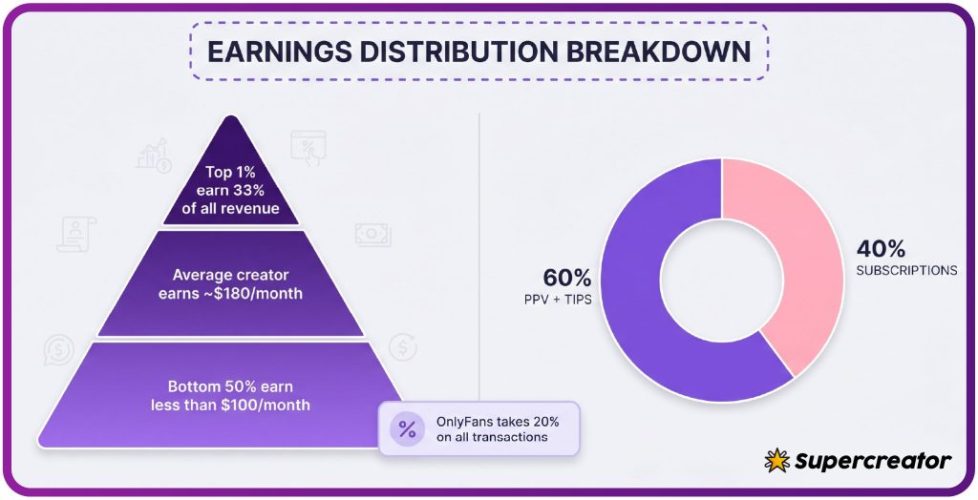
Verification holds of $0.10 confirm payment methods without charging subscribers. Platform mechanics allow base subscriptions from $4.99 to $49.99 monthly, with free pages earning via PPV messages up to $50 and tips reaching $100. The 20% platform fee applies universally across all transactions. A creator charging $9.99 monthly therefore nets $7.99 after the platform cut; a $3 promotional first month still yields $2.40. Subscribers should factor this into value assessments—creators keeping 80% have stronger incentive alignment than platforms with heavier fee structures.
Which Metrics Correlate With Content Consistency
Not all ranking data predicts whether a creator maintains reliable output. These six indicators, drawn from platform mechanics, offer stronger signals than surface popularity metrics.
- Posting frequency variance: Low standard deviation in daily content volume suggests sustainable workflows
- Content type diversification: Multiple format categories (photos, videos, audio) indicate production investment
- Account age with continuous activity: Creators active 18+ months demonstrate platform commitment
- Price stability history: Infrequent rate changes correlate with business model confidence
- PPV message volume patterns: Moderate, consistent paid message frequency versus sporadic high-pressure campaigns
- Tip menu standardization: Clear, persistent pricing for custom content suggests operational maturity
These indicators appear inconsistently across ranking cards. BestOnlyFans methodology weights longevity and posting regularity more heavily than raw subscriber counts, which research suggests correlates better with actual satisfaction patterns. Aggregators face pressure to maximize click-through rates, which shapes how data gets displayed. Watch for these five presentation techniques that inflate apparent value without improving accuracy.
Practical tip: When a ranking card shows high subscriber estimates alongside low engagement proxies, investigate further. This pattern often indicates dormant accounts or purchased follower inflation that ranking algorithms cannot filter.
Red Flags in Ranking Card Presentations
Ranking cards manipulate perception through selective presentation. These five common techniques substitute estimated data for confirmed information.
- Rounding subscriber estimates to nearest thousand or million, masking wide confidence intervals
- Displaying “average price” across multiple tiers without explaining promotional versus standard rates
- Using maximum PPV prices as representative rather than typical transaction values
- Conflating total content volume with recent output, hiding extended inactive periods
- Presenting estimated engagement rates without sample size disclosure
These manipulations exploit cognitive shortcuts. A rounded “500K subscribers” feels more authoritative than “estimated 450K–550K,” yet the latter communicates uncertainty honestly. Similarly, showing $49.99 PPV maximums implies premium positioning without revealing that most subscribers actually pay $5–$15 for base access. Consider a concrete scenario: two creators both list $49.99 maximum PPV. Creator A sends two $49.99 messages monthly; Creator B sends five $8 messages weekly.
The card shows identical PPV ceilings, yet monthly costs differ drastically—$99.98 versus $40.00, before tips. Most actual spending clusters in the $5–$10 typical paid range, making maximums misleading as comparison tools.

Cross-Referencing Multiple Ranking Sources
Single-source evaluation risks inheriting that source’s particular biases. Comparing how different aggregators handle identical creators reveals data reliability patterns.
| data point | BestOnlyFans | typical aggregator site |
|---|---|---|
| Subscriber counts | Range estimates with confidence intervals | Single rounded figure, source unclear |
| Pricing accuracy | Verified against public creator pages | Lag time 24–72 hours common |
| Content categorization | Multi-tag system with creator input | Algorithmic assignment only |
Data conflicts between sources indicate measurement uncertainty worth investigating. When one aggregator shows 300K subscribers and another claims 800K for the same creator, neither number should anchor your valuation. Instead, treat the divergence itself as information about data quality.
Cross-referencing becomes essential for promotional pricing claims. Some sites display expired first-month rates as current, while others maintain accurate real-time data. Promotional first months can drop below $4.99, but base prices may not—yet many cards fail to distinguish these clearly. A $3 first-month promotion reverts to $9.99; subscribers who budget for $3 face unexpected jumps. The auto-renew stop mechanism protects against silent price hikes—when creators raise prices, existing subscriptions continue at the old rate until term expiration, then require active re-subscription confirmation.
This prevents shock charges but demands calendar awareness.

From Card Data to Informed Subscription Choice
Ranking cards enable efficient screening, but final decisions require direct verification. This four-step process protects your subscription budget from card-based oversimplification.
- Price verification: Confirm current rates on the creator’s actual OnlyFans page, watching for promotional expirations
- Content sample review: Examine public social previews for quality consistency with ranking card claims
- Engagement pattern assessment: Check comment sections and recent activity timestamps for posting regularity
- Payment structure clarity: Identify PPV frequency, tipping culture, and custom content pricing before subscribing
Following this workflow prevents common pitfalls: discovering post-subscription that “daily content” means recycled archives, or that the attractive promotional price expires without clear notification. Step four deserves particular attention—creators with identical base prices vary enormously in total cost. One might include full videos in subscription price; another charges PPV for every video longer than two minutes. Without pre-subscription clarity, monthly totals can exceed budgets despite seemingly comparable card metrics.

Limitations of Aggregate Data for Niche Interests
Standard ranking metrics fail subscribers with specialized content requirements. These five categories particularly resist aggregation.
- Technical production quality: Lighting, editing, and equipment standards vary enormously within similar subscriber count brackets
- Interaction depth: Ranking cards cannot distinguish mass-message automation from genuine conversational engagement
- Schedule alignment: Your available viewing times may not match a creator’s posting patterns despite aggregate frequency metrics
- Content evolution: Directional shifts in creator output over time elude static ranking snapshots
- Community culture: Comment section norms and creator-subscriber relationship styles require direct experience
Subscribers searching popular onlyfans names often encounter this limitation immediately. High-ranking creators may serve broad audiences while lacking specific attributes niche seekers prioritize. Supplement ranking data with community forum discussions and preview content evaluation.
Paid chat rates of $3–$5 per message and custom content pricing also fall outside standard aggregation. These variable costs significantly impact total expenditure but rarely appear on ranking cards designed for quick comparison. A subscriber sending ten paid messages monthly adds $30–$50 to base subscription costs—potentially doubling or tripling total spend. the ranking site includes some communication cost indicators, yet most aggregators omit this entirely, making price comparison across creators functionally incomplete without direct page examination.
Building a Personal Ranking Card Reference System
Experienced subscribers eventually outgrow third-party aggregators for creators they follow long-term. Maintaining personal comparison data enables more nuanced evaluation than standardized cards permit.
| your tracked metric | source | update frequency |
|---|---|---|
| Actual posts per week | Direct subscription observation | Weekly logging |
| Price change history | Payment receipts and page screenshots | Upon notification |
| PPV purchase value | Personal transaction records | Per purchase |
| Creator communication patterns | Message timestamp analysis | Monthly review |
| Content type distribution | Download/archive categorization | Quarterly audit |
Personal tracking reveals patterns invisible to aggregators. You might discover that creators with lower ranking card scores actually deliver better value for your specific preferences, or that price increases consistently precede quality declines in your experience.

Security considerations matter for personal data systems. Store subscription records with the same care as other financial documentation, and avoid sharing your tracking methodology publicly where it might influence creator behavior. Remember that auto-renew stops when creators raise prices, though existing access continues through paid periods.
FAQ
How current is the pricing data on ranking cards?
Update frequency varies by aggregator. the ranking site verifies prices within 24–48 hours, while smaller sites may lag 72+ hours. Promotional pricing particularly suffers from delay, as limited-time offers expire before database refresh. Always confirm current rates directly before subscribing, especially when cards display promotional indicators.
Why do subscriber count estimates vary so much between sites?
Different methodologies produce divergent estimates. Some aggregators extrapolate from social media follower ratios, others from engagement velocity patterns, and still others from creator self-reporting. Platform mechanics prevent direct verification, so estimates remain speculative. Treat wide ranges as more honest than precise figures claiming false accuracy.
Can creators influence how they appear on ranking cards?
Direct manipulation is limited but possible. Creators can optimize public signals that ranking algorithms detect: consistent posting schedules, engagement-driving caption techniques, and strategic promotional pricing. However, most aggregators resist direct payment for placement. The larger risk is creators gaming the metrics that cards display rather than improving actual subscriber experience.
What should I do when ranking data contradicts my direct experience?
Trust your direct experience. Ranking cards aggregate population-level patterns that may not apply to individual cases. Document your specific observations and adjust personal tracking accordingly. If multiple subscriptions contradict card predictions systematically, consider whether your preferences align with the aggregator’s target audience—different ranking sites weight metrics differently based on assumed subscriber priorities.
